Monday, June 8, 2015

For My Sister on the Occasion of Her Birthday

Day Six


A little bit of della Robbia on a street corner in old Cashel for you

It is a fine bit of fate that today, June 8, is my sister's birthday and I have been able to call her on my cell phone to wish her a happy birthday.  I get to do this from the very launching spot of her great-grandfather's trek to America where he met a beautiful dark haired woman named Mary Shannon, whom he married, and thus started another generation.  One daughter of this union, Catherine Frances Butler, had a son (our father, who might be in heaven) who had a delightful, bright and funny daughter that he named Catherine Frances as well.  Happy Birthday Kate!

And as a gift I bring you news of your ancestors.

Beginning right away at an ungodly hour of 9AM which my body still registers as at least 3AM we had breakfast with other B & B guests.  The owner Tom amusedly asked us if we had discovered any relatives the day before.  We replied, no— only dead ones—seen on gravestones in the cemetery on the Rock.  When an American couple from Wisconsin heard the conversation they asked what name of relatives we sought.  I told them Butler.  Scott told us he was a Butler descendant and had only recently found out he was an Irish Butler since being here.  Tom said in his high Irish musical voice, " Oh, you found some live ones then!"  This family may have not known they were Irish but clearly their daughter Mary was culturally Irish and could tell fine tales in funny ways and had us laughing out loud with every story she told.  They shared their findings regarding their royal roots, or at least ties to aristocracy, that they evidenced with sheets of family trees and even an old microfiche with a family seal.  I had forgotten my glasses so I nodded a lot and took them at their word.  Travel well cousins.


More traces of a common name

Steve and I then went to a museum called the Bru Boru which purports to display the spirit and import of Irish music, poetry and dance culture.  This may be true on days in which some of the living performers of Ireland  come for live performances.  But when you are left to your own devices to wander an immensely overbuilt cavernous sequences of poetic and obscure descriptions of art that can't be described and that has only six long bronze horns behind glass, a rudimentary copy of the Brian Boru harp,  and one bell— you fail to really grasp the inspiration.  We were willing Americans and yet still couldn't get anything from the experience.  My advice: go to a pub on a weekend and drink.  You will get more than in this museum. They had hired a wonderful beautiful young female guide who spoke Gaelic;  that was just one thing that made it worthwhile in the end though.

The other huge boon of our visit here was that Brid from our B & B had told us that the museum had a staff genealogist and we might get help.  We have very skeletal materials along with us which I had forgotten even to bring so I was really pathetic in describing my connection to Cashel.  I think at one point I threw out every typical name that Irish boys have in lieu of the actual name of my great-grandfather's father.  Dierdre, a trim, sharp, green-eyed redhead with a matching flattering orange sweater was able to distinguish from the mass of my narrative verbiage that a Mary Ann Butler (Patrick Butler's younger sister) had married a Phillips boy from Cashel.  She disappeared into her gene cave for ten minutes and came back with gold in my opinion.

In her computer she found record of a Joseph Phillips marrying Mary Anne Butler in 1870.  Mary Anne  was 18 years old and Joseph was 25.  Significant for us, dear sister, is the listing of John Butler as her father, our great great grandfather.  There home is described as the Moor, an area outside the old city walls of about two blocks total on the map.  John Butler's occupation was that of a cattle dealer.  This profession is still very big around here.  I took a picture of the sign outside a huge cattle mart and animal pen.  From earlier photos you will see cattle everywhere here, in backyards and trimming the stoops of ancient ruined monasteries.  Diedre suggested we go to the Archdiocese of Cashel/Emly in Tipperary Town 20 kilometers away where they have diocese marriage death and birth records computerized.   Wish us luck in finding the name of John Butler's wife which will propel us back perhaps to the next level of this odd and probably meaningless hunt to know where we came from.


This alley certainly carried Butler relatives from The Moor to Main Street


We ate lunch here before even learning it is half a block from The Moor area


 The side of O'Neills and one of the few, maybe one of three, old buildings left in the area


 The ancient Red-headed Guard of The Moor lives on, he keeps vigil against bird invaders


And like something out of a movie, just as we were leaving, Deirdre came back and said she had spoken to Helen who had just talked to a returning Phillips that she thinks is related, and that we should talk to her. Helen looked her friend up in the local phone book but with no success, Helen didn't know her first name (Mrs. Phillips), but told us she was in her seventies, what her address was, and to ring her up in person and introduce ourselves, giving her name as a reference to prevent her from being suspicious.  We realized dinner time today was not the best time to impose.  So after our travels tomorrow to the ArchDiocese in Tipperary Town we will ring up my distant actual cousin on Wednesday as a departing treat from our soaking in of Cashel sights, politics, place and history.

HAPPY BIRTHDAY DEAR SISTER KATE!!!!


Cattle are still a big thing here in Cashel—Cashel Castle Cattle

A Tale of Two Castles in Cashel

Day Five


This day we have a good look at the Rock of Cashel and fill out some of the details of the area, and muse on connections.  I was not comfortable at first about asking people about the Butlers or my distant cousins with the last name of Philips.  Steve however is not shy.  The first person he stopped on the street to ask directions to our B&B was greeted with his statement, while he pointed at me, "She had a grandfather who was born here by the name of Butler and we are looking into family ties." The nice man put his hands up in feigned protest and joked, "Look, you have to know there is no money here!"  Hilarious.


He confirmed there were lots of Butlers here, and in Tipperary in general, and Philips too.  Again at the B& B Steve told the owner Brid O'Brien of our "search" and she remembered a Philips that had recently died at a ripe age, after being a contractor and a rugby player.  Random musings on common names.  It has become clear that whatever happens in my "hunt" (as Tom O'Brien the other  B&B owner called it) I am walking the landscapes of my ancestors for sure, the churches, the streets, and the vistas would have been imprinted in their psyches and I can at least have this connection.


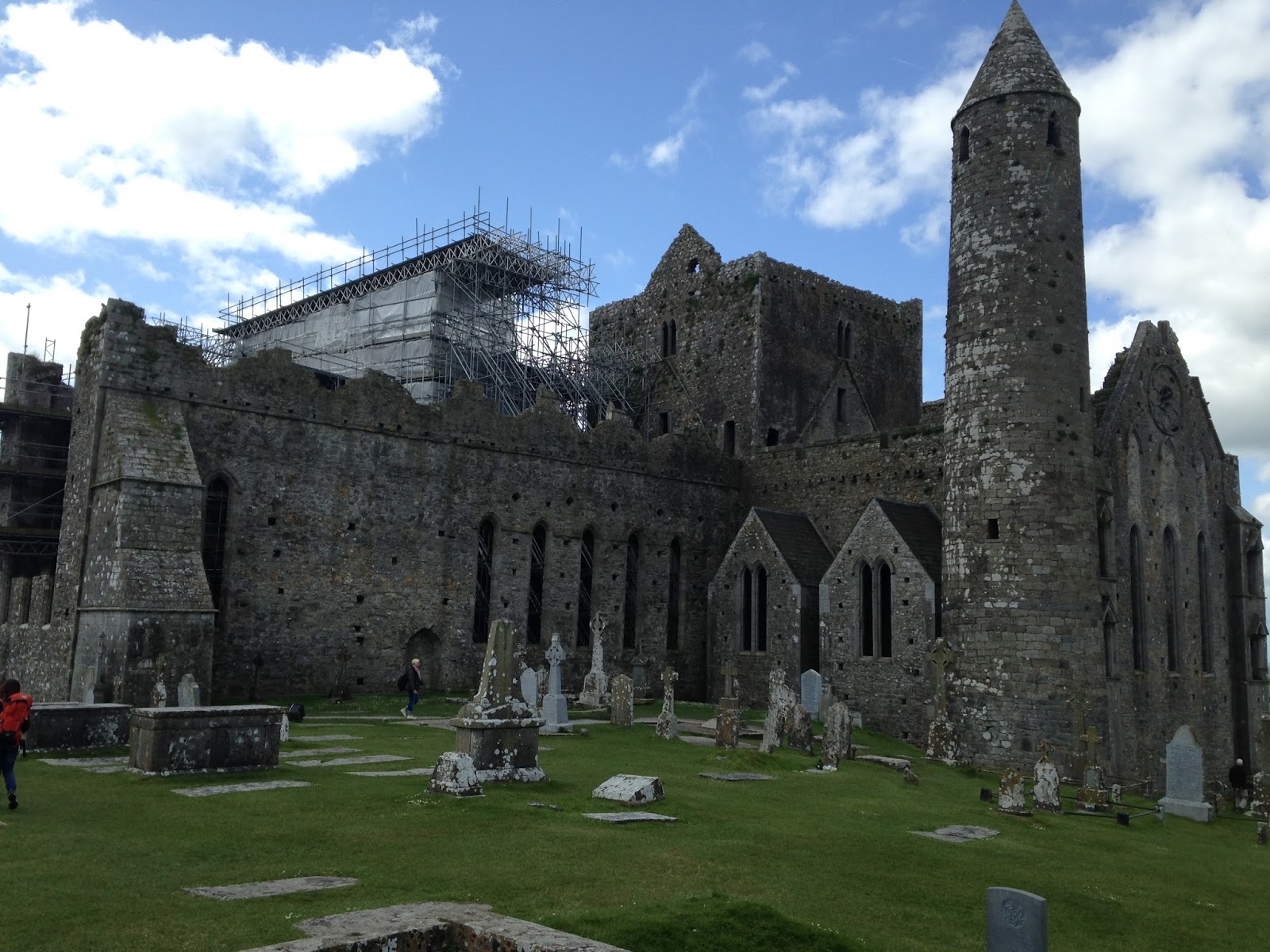
We headed up on foot to the top of the Rock of Cashel.  Sheep grazing the hills, jackdaws in huge numbers wheeling around the tops of the ruin.  We took a very fine tour with a young bearded redheaded guide, then took each site in again at our own pace.  We noticed some kids rolling and rolling down a grassy slope and I commented to their Dad that they looked very safe and happy.  He said he had grown up in Cashel and the Rock had always been his playground as well except that when he was small there were no gates and children could climb up and up into secret tunnels, through windows, and along damaged walls.  Now they are all safe from a potential accident.  But something has been lost.

Initially I agreed that this was a blow to children's happiness to be prevented from scrambling the ruins but after talking to another older guide who also used to scamper here as a child he gave me a different perspective on "loss."  He noted that Ireland's many magnificent ruins were in great part in worse condition than they might be because until the Republic was formed in the 1920s the guardians of Irish heritage did not really care for Irish heritage.  These "ruins" might have been more carefully maintained had the Irish had control of their land, churches, monuments and history.  So now he noted, Ireland was doing a great deal of catch-up on its wealth of artifacts and the maintenance issues are being tackled one expensive project at a time.


Irish cross with a circular "sun" arm-support system that appealed to pre-Christian Irish


 Any chance to read is taken, of course it was a guide book


The holes left by wooden scaffolding used in original construction are perfect nests for jackdaws

This same guide was forced into listening to my tale of my G-grandfather's story.  I think the Irish have to bear up under the weight of the tourist interest of many American seekers of a "homeland".
He was the first to really think about this story out loud with us.  He felt it unlikely that my GG had bothered to place an Irish flag way up on this unpeopled remote ruin in the 1850s.  More likely he thought it might have happened in the middle of town, either at the Palace built for the Archbishop of Cashel in the 18th century or at "Kearney's Castle" a prominent towered building near Main Street that had once housed the infamous Lord Inchiquin whose real name was Murough O'Brien - who attacked the town of Cashel in 1647 and slaughtered hundreds (some claim three thousand) of people by trapping and burning them to death in the Cathedral on the Rock of Cashel where they had taken up defenses.  My family story had been about the "Castle Cashel" not the Rock of Cashel so I think now if my GG's story is true than it is probably here that he made his statement.


The Castle added in the 1400s, shortening the nave, to the Cathedral on the Rock


Kearney's Castle, named for original builder, on a main street of Cashel proper, near a square. 

We also toured the Catholic Church, St. John the Baptist's and its cemetery.  These would have been ancestral "haunts" as well.  Tired from our hike all day we had lunch around 3PM.  Sausages and mashed potatoes in an overly ample serving with a side of french fries!  Two potato dishes in one meal, could this be Ireland? We skipped dinner unless you count the Jameson's and chocolate.


St. John the Baptist Catholic Church.  I know my GGGrandfather and GGGMother were here


 Tribute to your church, your parents, and forever, importantly, yourself


People here are so friendly and funny.  The stories are true about that.  Wherever we go we get into detailed hilarious fun talks that make the day both luxurious and full.  Kind of like trying to drop into the Port Townsend Co-op and get out with a pound of butter within a half-hour.  If you know what I mean, locals will.


Tourism is serious, hard study, fueled by coffee

Sunday, June 7, 2015

Road Trip to History

Day Four


This is the day that we leave Dublin for the road trip.  That means we are getting a car, that means we are driving on the left, that means I feel like I am getting sick at the thought.

But first we had a morning to kill.  Steve and I love old history, artifacts and archaeology. We thought the museum called Dublinia would give us a detailed view of the Viking presence here in Dublin, something that would make transparent the layers of occupation under our feet.  Not quite.

Dublinia is for kids.  It is Disney with no animatronics.  It is gory papier-mache battlers, wild-eyed mannequins in bear shirts (Ber - serk is "bear shirt" is bezerk), Catholic clerics being slaughtered, replicas of docks, markets, kitchens, and ships.  There is a whole exhibit on the use of latrines with a expressive guy in a tunic with his pants down - a loud speaker adds farting and groaning.  Thank God they refrained from smell-around, oh wait, they didn't.  It is for kids.

We did find an actual tunic and pants-wearing, amber and knife bedecked Irishman showing how coins were made.  We talked to him for about a half hour.  He is married to an American and spends winters in Phoenix exhibiting authentic medieval crafts at the big Renaissance Fair there.  (He is not with Society for Creative Anachronism for those of you who might wonder).  At the very end of the exhibit Dublinia discussed archaeological techniques and displayed maybe six authentic artifacts.  Those six artifacts were part of a room displaying a huge Dubliner protest —using photos of marchers and newspaper articles— protesting the construction of Dublin's City Council building's modern concrete and glass complex that placed itself squarely and forever on top of the hastily assessed actual site of the large Viking village that began the city.  The artifacts were a small portion of what they did manage to find.  When you leave the Dublinia building you realize you are directly across from the street from this site of cultural self-immolation. The modern building does little to provide consolation.

This image is already captioned, double click to read it

Moving on.

We rented a small car in downtown Dublin.  The young man at the desk (Steve thought he was about thirteen) asked us how long we were going to be in Ireland.  We answered a month, and without a second's space he replied "What could you possibly do for a month in Ireland? " When we asked him to give directions out to the highway, he said " Turn right and then you are on your own"

No truer words were ever spoken.  We lost ourselves amongst tiny roads, unmarked, and had ABSOLUTELY NO IDEA where we were.  I will report that it was neither my nor Steve's finest hour of composure nor mutual treatment.  Steve made a few errors, classic ones, which he now allows me to share.  He turned left into the right lane, with me screaming at him to pull left.  He soon overcompensated by running up onto the left curb of a road that fortunately had no parked cars.  After screaming and detaching myself from the gear console, I was literally shaking.  Adrenaline was pumping non-stop,  I started to have stress-induced asthma.  Everything about driving on the left is WRONG, everything I ever have been taught— I am supposed to undo instantly.  All of my goody two shoe nature and strict adherence to law has been ripped from its moorings.  The sun is rising in the goddamn west I tell you.  Only the relative peace of the less complex arrangement of an actual marked freeway led to any calm.  My other tranquilizer was our trusty phone that led us through every turn.  I clutched it a little too hard, making sure we did everything it said to get out of Dublin and get to Cashel, our next destination.

Cashel is the birthplace of my great-grandfather Patrick Butler who left Ireland at the age of fourteen.  The possibly apocryphal story is that he ran the Irish flag up the Castle Cashel in around 1855 and his parents, rather than see him go to jail for treason, placed him on a hay cart for the west coast of Ireland and he was on the boat to America and New York relatives within a week.  My question for our five days here is simply - could this be true?  Was this a story my grandfather told to garner Irish revolutionary points and bragging rights?  Was it to cover-up the real reason he came to America alone—perhaps he had gotten into less glamorous trouble?  Did his family just send him to America as the one sowing of one seed that the oldest son might reap benefit from?

Cashel is a lovely place set in a broad valley, the once walled city lies at the base of a limestone outcrop atop which have been iron age fortifications, fortified thatch-roofed villages, the seat of the Munster kings, and then around 1100 AD, the first Romanesque church in Ireland (with colorful frescoes found under reforming Protestant whitewash) and then a huge gothic cathedral.  This complex is the rightfully famous Rock of Cashel.  Our bed and breakfast (O'Brien's Cashel Lodge) is at the base of this with unobstructed views of the Rock and Hore Abbey (named Hore as its Cistercian monks wore undyed sheep wool robes that were as white as hoarfrost) in our front yard.  Note the cosmically beautiful photographs and soak it all in.


Rock of Cashel from our B and B, an unobstructed incredible view, note all of the jackdaw crows


Hore Abbey, across the street from our B & B


Late evening light at Hore Abbey


This is our B & B —O'Brien's Cashel Lodge.  We are in the upstairs room, left, a converted cow barn


Join me tomorrow as we begin our investigations of this story on "yet another exciting entry."


Saturday, June 6, 2015

Sea Sighed

Day Three

We are going to have to stop having so many serendipitous good times as I am not getting recreational reading accomplished.  Only this blog.

Today, as in yesterday, as in Friday which in many regards is Thursday in the States, as in precisely Friday June 5 we slept in.  I find myself referring to what time it is eight time zones away and I keep noting that you are all asleep most of the time that I think of you.

Today we only planned ONE THING!  We took the tram to Howth Head which is pronounced Hoath Head.  We learned that by mispronouncing it.  Howth is a forty minute ride away north of Dublin.  We chose it as a destination because it has interesting seabirds and we needed to get bang for our buck of a bus pass.

What a pretty spot.  I will let the photos speak for themselves.  We had a very nice lunch in a fish shop of two small plates, one of perfect prawn scampi and sauce, and the other of grilled mackerel with cannellini beans, sun dried tomatoes and green garlic pesto.  We planned to leave the working seaport there and stroll along a beach and up a hill to the lighthouse.


Fish Shops in Howth


Working waterfront in Howth


Steve had noticed a boat that had disgorged many passengers and looked like a ferry or tourist cruise so we stopped there and I asked, "Where are you going?"  Dun Laoghaire (pronounced Dunleary).  "Have you room for two passengers?" Yes. "How much is it?"  After some thought the money man gave us both senior citizen fares, these were listed next to a hunched man with a cane symbol.

The Captain had been in the Navy, in merchant shipping in the Middle East and he was quite charming and funny.  Now he plied Dublin Bay in his retirement, circumnavigating two bird and guano-covered isles and depositing people between Dublin's favorite fish market (Howth) and its favorite ice-cream consuming town— Dun Laoghaire.

We learned these distinctions from a married couple who were seeing Dublin from the water for the first time.  Though from Donegal in the north the woman had been to Dublin all her life to visit her grandmother but had never ridden a boat nearby.    The man was a birder and would yell things like "Razorbills!"  He confirmed my two lifelisters (that is a word to a birder) as Manx Shearwater and Black-legged Kittiwake.


 From Howth pier


 Leaving Howth


Howth Head Lighthouse


 Looking back toward Howth Head, lighthouse and island seen above


Dun Laoghaire pier

We really just stumbled on this trip, my mini-pelagic bird trip.  If we had lingered at lunch we would have missed it.  Because we never planned it there was neither the stress of making sure we got there on time nor would there have been any sense of loss had we missed it.  This is stress free travel.


Friday, June 5, 2015

Vellum and lots of ink

Day Two

Sleep!  Real sleep!  Comfortable bed at Kelly's Hotel—a fairly rustic and hip-a-delic hotel south of the Temple Bar district.  They provide ear plugs instead of mints.


    Minimalist to the Max, rustic to the point of precious, but very likable hotel room


 Steve hanging with an old friend of his from his College Days


First planned event was a visit to see the Book of Kells at Trinity College about five blocks away from our hotel.  Photographs were strictly forbidden, even of the reproductions blown up in the good overview in an explanatory exhibit.  The truly amazing thing about the Book of Kells is that they have survived down through the millennia (800AD), once recovered after having been stolen, also escaping destruction by Vikings and later Cromwellian soldiers.  We were able to look at two pages on display in two folios of the gospels.  The work was so fine and unimaginably executed.  No two designs in the thing are identical.  This was a pilgrimage for me; my father, an amateur calligrapher, was besotted with these manuscripts.  I now understand.


The very page of illumination that we saw, its subject: "With him at crucifixion were two thieves" Be sure to look at this one in large format.  Photos off the internet

                                 A page similar to the second page we viewed, no two designs alike

Another of the fascinating things in the exhibit was a huge thistle brooch (900 AD) from Cashel, the birthplace of my great grandfather.  This brooch must have weighed two pounds and was about six inches across.

                       Men's jewelry from the tenth century. Internet photo


We saw the oldest harp in Ireland in the fabulous Long Room library, the basis for all of the harps woven into my inherited Irish linens, a fundamental symbol for the Irish and for Guinness beer. The library is gorgeous.


The oldest harp and the longest library.  Be sure to blow this one up to full size.
Photo off the internet


The library: the happiest place on earth


We left Trinity College and strolled down a pedestrian street full of street performers and expensive shops in order to reach a 22 acre patch of green —St. Stephen's Green —and lake that actually has birds other than pigeons—though there were plenty of those.  I saw two lovely long-tailed tits, and a blue tit that were all quite titillating.  I had to make that said before you did.  Also Eurasian blackbird, magpie and robin.  Now we're talking travel!


Street sculpture performers, you donate and they move slightly. On Grafton Street


We had stumbled upon a small sign and locked foyer of a yellow and white row house that said Friends Meetinghouse on our first hallucinatory amble through town before check-in.  We noted the next Meeting for Worship time was 6:15 the following day.  We managed to arrive there on time, get buzzed in from the street.  Fran with a thick brogue, all in green welcomed us warmly.  It was a surprisingly small room with chairs and detached benches set up in a square.  About ten people were there.  We had tea afterwards and learned of the odd growth of Dublin's Meetings.  We were attending the Dublin Preparative Meeting which was derived from the larger Dublin Meeting which still owned the building but had branched into three locations in south Dublin that were more in the suburbs.  About thirty to forty members still clung to a Temple Bar presence here while the larger Meeting was renting its original men's and women's Meeting rooms (rooms as at Arch Street in Philadelphia) to the Irish Film Institute.

We talked of Irish Quaker history over tea, how banished former Cromwell loyalists fled England and settled the north of Ireland.  How these became identified as Quakers we didn't manage to discover, but by no means did Irish Friends attract lapsed Catholics in any great number but rather were displaced English.  We talked of similar Quaker trends of declining membership and how children had become certainly a rarity at the downtown site.  There is no parking and little residential proximity.  One man commented in general they are fewer but now more effective in their activism.


A blue tit
Photo off the internet

Had a great dinner at an insanely packed alley full of people of all ages having their pints, what a press of flesh.The concept at this restaurant 'Jo'burg was to pick your burger type - beef, lamb, chicken or two kinds of veggie, then pick your bun or no bun or just one bun, and then pick your flavoring —in my case I had peach curry and emmental, and Steve had roasted red pepper and almond pesto.

And as if the day weren't full enough we went to a pub called M. Hughes where traditional Irish music of the sort that Steve is fond of is played from 10 PM on.  We listened for a while in the room that was closed off from the rest of the pub, what Steve says is a "snug." Between sets there was indeed the famous "craic" (pronounced crack) he had hoped to hear.  Outrageous stories of spilled beers on famous players, or insults deftly delivered and descriptions of odd characters were given as punctuation to the music.  Steve took up his mandolin for about a third of the tunes though he stayed out of the inner circle, and we were by and large ignored.


Mrs. O'Bleary

Day One

Propelled by the excitement of our arrival in Ireland we bought a three day bus pass and headed toward our hotel.  Knowing it was too early to check in we left our baggage there and started to walk around downtown Dublin.  We encountered the Dublin Castle site shortly, and in the kismet that I fear we have come to expect, it was free Wednesday and the first tour of the day was to be ours.  This was the perfect introduction to Dublin and Ireland in general. Built on the site of a large Viking village at the confluence of the smaller Poddle and the Liffey rivers in a place they called Black Pool (Dubh Linn) the palatial Georgian-looking Castle square was first an English fortification, then a castle, chapel complex for English Viceroys, and the site of the handover of rule to the Republic of Ireland — where Michael Collins raised the Irish flag at long last—and now a site for inaugurations of the prime ministers (The Taoiseach—"chief" in the Irish language) and state visits. In the 1960s renovations led to the excavation of an old fort gun powder tower and part of the medieval walls of the ancient larger city. We descended the stairs to see this dank-smelling underlayment to the bustling town above.  In about two exhausting hours we were brought up to date on much of the history of Ireland.  We particularly enjoyed our guides brogue and attitude toward this by-and-large oppressed homeland's history.  In regard to a decision to close the Police Museum at the site he said "Many Irish are rather sniffy about the police, that is until they need them for anything and then they call right away.  Personally I think they do very well for an unarmed force."


Dublin Castle courtyard and one of the large reception rooms of the State apartments.  The Irish have lovingly maintained the oil paintings of their overly bedecked and beplumed former English Viceroys.  No destruction of historical truth in service to Revolution


It was minutes after leaving this great introduction tour that I realized I was in desperate need of sleep. We waddled (Steve wishes to point out here that he does not waddle) to yet another historic site and all I could do was sit on the bench and blink in the sun— occasionally lifting my head to look at the impressive facade of Christ Church.  We had choices.  Go on another tour, sit through Peace Prayers at Noon (and fall asleep) or just catch a bus, any old bus and ride it for a full circuit.  We got on the bus.

We startled the driver who at the end of the line came up the stairs of the double decker to find two sleepy Americans still ensconced.  We had ridden for over an hour to the outskirts of Dublin south, dull tracts of suburbia lulled me into a deep sleep which I couldn't break until Steve roused me at the end of the line back by our hotel.  We finally got to check-in and slept for three hours.  Revived, we had an Indian dinner with beloved onion bhadji appetizer.  Here we struck up a conversation with an Irish woman and her German boyfriend about the boom times in Ireland, immigrant beggars making 200 quid a day, labor union differences between the U.S and Ireland, books and general morning grumpiness.  I was struck by the pluck of her, the storytelling, the enthusiasm she had about so much interesting stuff.  I told stories myself, funny ones that elicited real laughter.  I thought to myself perhaps I am Irish.

The view from our doubledecker bus while I was still conscious

Thursday, June 4, 2015

Circadian-navigating the World

In the hope of staving off jet-lag we have a strategy.  We travel and visit our daughter Irene on the East Coast for a few days before jumping the pond.  This is not a hardship.  I add a few east coast birds to my year list. We bask in the non-virtual, non- "text" usual wonder that is our grown and thriving girl and her young friends.  It is a gift that completely recharges our confidence in her, her choices in life and school, and our luck and joy.

Amongst the various things on this leg of our journey were a great dinner with a big group on Friday, a  trip to the Franklin Institute exploring the technology of weaponry of Genghis Khan (shuddering to think about the swords' pasts) and taking in the Giant Heart exhibit, and dealing with Irene's stalling car.  Ultimately we decided her car was not up to the task of taking us to JFK on Tuesday so we signed up for a shuttle.


I can't tell if these are different species or just different moments in a dogwood's life


The shuttle trip was incredibly long as we wound around neighborhoods on the outskirts of Philadelphia picking up its eight passengers.  We left at 11:30 AM and got to the airport at 4:50 PM.  There was a Turkish man, an African man, an Indian family of three, two Moroccans and one Lebanese traveler amongst us.  It truly felt that our travels had begun.

I thought I had booked a British Airways flight to Dublin.  It actually was, in a  bait and switch maneuver, a jam-packed American Airlines flight.  Every inch of cabin space had been used to create seats.  We sat like praying mantis—our arms doubled over and mincingly placing food carefully up to our mouths.  I commented to Steve and the Irish man next to me that we would be more comfortable feeding each other.

Six and a half hours to Dublin in a race to sunset and sunrise that all eastern trips at night are. The seats were so close that  I felt I was spending the night with two men and the best way to handle all of the coziness was just to relax and enjoy that novelty. Suffice to say I didn't really sleep at all.

We descended toward Dublin at about 6AM — a city ringed by odd barren tors or hills that looked like ancient volcanoes.  We had seen so many of Ireland's rock-ringed fields from the air.  This was a heavily worked-over place, wilderness schmilderness, and already it was clear that my ancestors had to have been hardier than I ever had or could ever be.