Thursday, June 11, 2015

Sean O' Dubhuir of Cashel

Day Eight -June 10 PART TWO


We entered Mikey Ryan's pub to find various ages of men, two older gentleman at one end of the bar, two middle aged men in rugby jerseys of ample size to cover a multitude of sins and one young man.  I asked if  Johnnie O'Dwyer was there.  A beat later the barman said "Oh Sean... yeah, he is in the back room- through there."  Interrupting Sean and a friend we quickly said our introductions mentioning the O'Brien's,  and then we were off on the ride of our lives.  Sean O'Dwyer spent the next four hours with us, telling us of town, Phillips, Butlers, Irish and his own history, sprinkled with a greeting to every living human that passed and once in the cemetery to dead ones as well.  But I go too fast. 


We offered to buy Sean another coffee but as he had rights to a refill he bought us coffee instead.  He escorted us to the beer garden on this beautiful day and when he got up from the tall stool he was the same height as he had been seated.  He had a little terrier on a lead that he took everywhere.


Out to the beer garden.  Steve has his I-phone recording until it couldn't take in anymore


Baneen - the cutest devoted little dog with as much energy as her owner.  


A more pleasant fun experience with another human being I have not had yet. There wasn't a moment of pause or fatigue in what became one of the best, generous and laugh-filled interactions we have had here.  It was as if we were beloved family.  This from a man with five grown kids and sixteen grandchildren.  He and his have lived in Cashel for a very long time, and he knew the last of the generation of Phillips' that my dear cousin Ray had met.  One point he made repeatedly was that this branch of the Phillips did not tend to "produce much issue" and the only hope I had of meeting a Phillips from the Butler line was a jockey cousin who only periodically visited Cashel. 

But he did tell us of his friend Michael Phillips, the same one Brid and Tom knew; that he was an actor and that both of them had been in many plays together, and that he would drink and write poetry.  Sean offered to take us to the church cemetery at St. John the Baptist.  His walking pace was very quick, and I could barely keep up.  He greeted people with jokes and salutations as we walked.  People would ask him pharmacy questions. It was a dance.  

At the church he marched us into the office where we met the priest and the administrative secretary, Maisy, and an affable parishioner he introduced as the local bishop (haha).  In rapid English sprinkled with Gaelic Sean persuaded Maisy to not put us off today as we were leaving but rather immediately start compiling files on Phillips, Butlers and Mahers (pronounce Ma like in hat, her, but really clipped).  She protested and threatened revenge and huffed but Sean relented not—all in good humor.  Bridget Maher turned out to be my great grandmother, married to John Butler.  I found her name right there in my notes that I had brought, but had failed to provide the genealogist at Bru Boru museum.

He told her we'd check out the churchyard graves and come back for her findings.  Sean walked directly to the Phillips walled grave plot.  And there I stood in front of not only Mary Ann Butler's grave but perhaps also her grandfather's grave, my great great great grandfather who died in 1817.  The wording "In sacred memory" makes me wonder if it is a new stone at his site or just a memorial. Anyway it was cool.


 The word Ladyswell is the street name in Cashel.  Even on graves you need more than a name as an identifier as the families were large in number and all had similar names.


Happy People gleaning bits of their quest 

When we got back Maisy was still xeroxing pages and pages of Phillips and Mahers —family names that were utterly uncross-referenced.  She mentioned that the Family Heritage Center in the town of Tipperary had them all on computer so we insisted she should stop and that we could go there for these records. 

We really fell in love with Sean O'Dwyer, he would chat everyone up as he walked along, but never for too long.  He was beloved by his dog.  He spoke and recited poetry in gaelic and said that he thought about things in that language first.  He has written a book about Cashel which he gave us as we left.  I got a nice kiss on the cheek and a real sweet fare thee well.  When Steve and I went to lunch after our parting from Sean I was quiet and reflective; there was a sense of love, gratitude and grace.  We were so well treated here in this little toehold of family history. The beautiful thing about Ireland is clearly its people.  This is as hardscrabble a landscape as any northern European country. One might expect a matching flintiness in response to centuries of hardship and political oppression. Instead here is a group of people who have decided there is a great consolation in response to the troubles—humor, warmth, poetry, music and genuine interest in others.  I am charmed, to say the least. 


One Thing Leads to Quite Another

Day Eight - June 10th PART ONE


Mikey Ryan's Pub Window

This trip has been a lesson in serendipity.  So much that is happening could not have possibly have happened had not other serendipitous unplanned things occurred minutes, days or even years before. It is a form of magic, with its own pace.  The lesson for me is that most good things don't happen when you plan and force your will to reach some shallow analytical goal.  Even the setting of goals can get in the way.

Many years ago, about 2006,  I toured an old house that had once belonged to my great uncle in Chicago in the 1930s.  I asked a complete stranger to show me her house, and when I produced photos of my family in it from the 1940s to give to her in thanks she told me she already had the whole set.  She said some old man had given her the set when he had toured the house on an architectural tour two years before.  "His name was Ray something."  Ray Kane? I asked.  "yes, that's it, he lives on Lakeshore Drive in downtown Chicago." There had been a rift in my family and the Kane cousins had been lost to us for almost fifty years.

This lucky break led me to my first cousin once removed.  92 years old, spiffy, mannered— with a Studs Terkel accent— he was the keeper of my father's generation family lore and back beyond.  He had created a family tree 27 feet long and had visited Cashel in the early 1980s and had found the Phillips connection to the Butler line and had met three (living) cousins in person.  I would never have known of the Irish flag story, who had married Mary Anne Butler, how my great grandfather had fared in his early years, nor personally how good whitefish is, and summer whites, and large cars and fedoras—without having known Ray.  He is gone now but when I left Chicago I felt I owned my history.

A similar thing is happening here in Cashel.  I thank and bless my fully engaged and warm cousin Ray first and foremost, and now I also thank the many unrelated people of Cashel who shared so much with me in such a short time. This is the next round of feeling at home and in ownership of my past.

This was to be our last day in Cashel.  We were going to check out of the B and B and head for Tipperary's Family Research Center and see if they could sort out any genealogy for us at their computerized collection of church records (for a fee).  I greeted Tom O'Brien as he cleaned up in the kitchen from breakfast and he asked where we were going.  In a parting conclusion I remarked to him that so much had been evoked for me in the trip, that I could smell the dung of the cattle market and feel the lay of the land.   I also mentioned that I had found out that the Philips man who'd married my great great aunt was a slater.

Tom said, " A slater? a roofer?  then I do know which line of Phillips you are talking about.  I think a Phillips put the slate on this roof.  They were all chippies (carpenters) or slaters, tradesmen all of them.  I was just talking to Mikey McCarthy about the Phillips.  Yea - they owned the house where the Rock Restaurant is.  You could see that.  It is on the street that widens there, by the Esso station, back in the day the street held the Cattle Market day, hundreds of cows filled the street from the Phillips place all the way to Friar Street. Mind you I have only been here forty years, so I'm considered a blown-in, but I am pretty sure that's the Phillips you are related to." So here the mention of the word "slater" changed everything.

When we handed in the keys to Brid O'Brien, Tom relayed his theory.  This opened a delightful memory of Brid's on the last of the Phillips that the O'Brien's knew —Michael Phillips.  Both were very careful about what or rather how they would say anything about this flamboyant cousin, a sacristan, a poet, and a man quite susceptible to the alterations of mood that beer can produce. In the end she concluded with "He was an artist really, and they can be different and that is a fine thing"  She then suggested if we had five minutes we should pop in on Johnnie O'Dwyer (Sean O'Dubhuir in Irish).  He was friends with Michael Phillips and knew so much of Cashel history that it would be worth our while.  I asked Brid "Do you really think five minutes will be all it will take?"  We weren't in a hurry at all and I knew it would be a good tale.  She laughed out loud and with a knowing smile said "no...:.

First off we went to the old Phillips home and toured around it, and in it and checked out the widened street and the vestigial traces of cattle pens in odd corners.


The old Phillips place


The widened cattle market area and old pen

We asked at the next door drug store owned by Sean O'Dwyer if he was in.  They phoned his home and confirmed that yes he was out and about and to try one of his other two stores to find him.  Tom O'brien had relayed earlier that if we didn't find him in the store we would probably find him in Mikey Ryan's pub with its excellent beer garden.  He would be only having coffee at this time of day.  Not only was this exactly where we found Sean but it was another example of everyone in this town knowing the habits of everyone else, where they lived, what they did and how to get what you need for them in the most humorous manner.  There is no better directory in this town than to ask a local.

I am going to break this day in two because Sean O'Dubhuir deserves his own entry, his own page, and a medal for energetic enthusiasm in the service of our search. He is one hell of a guy.


Wednesday, June 10, 2015

Well I'll Be

Day Seven


The antlers of an extinct Irish Deer in the banquet hall of an extinct Irish line of aristocracy

On Day Six I had been given some hope of finding living relatives still in Cashel.  I had an address, a last name of Phillips and a description of a woman in her seventies who wore glasses.  We went up to the door of Number One Cathal Brugha Lane and knocked on the door.  No answer.  I knocked again.  This time a very thin young man, about twenty, with braces on his teeth and tattoos all over his forearms and knuckles comes around from the backyard to check us out.  This quest of mine forces me to use whatever humor, charm or friendliness I can come up with on the spot, and have my impertinent questions delivered with some coherence and brevity.

"Hello, my name is Monica and this is my husband Steve, we are from America and we are looking for a woman at this address with the last name Phillips.  We think she may be a relative."  In the U.S. I would have thought maybe this young man would give us an unfriendly syllable or two.  But he was very nice to us, said he thought a Michael Phillips lived up at the next corner, and we should try there.    I thanked him for putting up with genealogical questions from distant Americans.  As we walked up the street, Steve asked a man walking briskly by if he knew where the Phillips place might be.  He said "Yes, and there is the man himself right there"  Before we could catch him he had gotten inside.  So again,  we knocked on the door. My knees were knocking too. I don't much like intrusion in either direction.

We stood on the porch and introduced ourselves and I asked him if he was indeed a Phillips as the neighbor had said.  "Aye -I am, please come in"  ( I think he said aye, maybe he stuttered).  My interior mind was going 'OH NO, imposition on our part!'  Exterior words were "thank you, that is very nice."  His wife Noreen was a little chilly at first but my spiel was as bubbly and to the point as I could make it.  It turned out that this Phillips was not related at all to our Phillips but we began to call each other cousin anyway and laughed about how many Phillips there are.  We stayed at most ten minutes and as I went out the yard gate I realized we had not gotten his first name, just his last. I guess since he wasn't kin I completely dismissed the formality of asking his full name.  Rude Americans!

Sometimes a dead end is a relief.  If there were no living Butler/Phillips relatives in Cashel we could just relax.  Why not then stop the search and travel to the nearby town of Cahir (pronounced Care) and do some straight forward tourism of a castle we had been encouraged to check out?

Here is a panorama of that castle along the Suir (pronounced Sure) river.  Please note the following photo to understand the power of the spheres of woo hoo operating in our lives.


Cahir Castle, built in 12th century, and owned by one family from 1375-1961


Baronry? Castles? Wealth?  Where do cattle come into that?  Where does famine?  Anyway we got a kick out of pretending the Cahir Castle could have been ours.  Did anyone catch the irony of Butlers calmly and carefully handing over their castle to Lord Inchiquin in 1647, who then killed hundreds of Cashel citizens (if not thousands) and would lead a young Butler to risk his freedom two hundred years later to protest at Inchiquin's Cashel home base in the middle of town.  No?  Well then you just aren't as excited as we are.

I have decided to spare you the details of the architecture of defense of Cahir Castle and all the pictures I took of them.  I will spare you the arrows from the ramparts, the bullets from the gun holes, the hot oil, animal fat, rocks and arrows from above doorways, the missiles of early germ warfare of dead animals and rotten yucky things, the tripping stairs, the traps beyond the first gate, the general ugliness of the period and leave you with only the one welcoming cross that greeted anyone who stepped over a Butler threshold into the family keep.


This was a crossbow porthole to pierce the armor and flesh of visitors from America who wished to know if you were perhaps one of their relatives

While we are talking of nasty things —Steve wants me to question you all about whether you know the origin of the word Wardrobe.  In the olden days of castles a wardrobe for clothes was called a garde-robe.  Oddly this word was also synonymous with toilet or biffy or shitter or whatever you call the place in the castle that hung either over the river or was cleaned out once a year.  Clothes were stored in the same room because the ammonia from the accumulated mass of blecch gave off ammonia which repelled lice. 

The garde-robe or royal coat closet of the Butler family about five stories about the River Suir

Not one of the Baron Butler's family actually wanted to return to the castle after Inchiquin took over, though the family owned the land until 1961.  They built a number of much nicer less fortified homes in the area. One of which we also visited.

The 10th Baron Cahir, aka the first Earl of Glengall aka Robert Butler and his wife built this sweet folly, known locally as the Swiss Cottage, in the "cottage orne" (or-nay- I don't have an accent mark) manner in the beginning of the 19th century.  Completed in 1810 its rustic charm was only used for day outings - picnics or recitals or resting.  No one from the family ever stayed here.  Restored in the 1980s it was a wonderful treat for us at the end of a mile and half walk from the Castle.


The Swiss Cottage 1810- rustic thatch, trellis work, roses and whimsy


I have to say I am not wishing I had been one of the 'fortunate' ladies of the Butler house in the 14th Century.  Life was brutal, cold and restricted.  In some places it still is today as well.  I am grateful for my ease and joy. 


Monday, June 8, 2015

For My Sister on the Occasion of Her Birthday

Day Six


A little bit of della Robbia on a street corner in old Cashel for you

It is a fine bit of fate that today, June 8, is my sister's birthday and I have been able to call her on my cell phone to wish her a happy birthday.  I get to do this from the very launching spot of her great-grandfather's trek to America where he met a beautiful dark haired woman named Mary Shannon, whom he married, and thus started another generation.  One daughter of this union, Catherine Frances Butler, had a son (our father, who might be in heaven) who had a delightful, bright and funny daughter that he named Catherine Frances as well.  Happy Birthday Kate!

And as a gift I bring you news of your ancestors.

Beginning right away at an ungodly hour of 9AM which my body still registers as at least 3AM we had breakfast with other B & B guests.  The owner Tom amusedly asked us if we had discovered any relatives the day before.  We replied, no— only dead ones—seen on gravestones in the cemetery on the Rock.  When an American couple from Wisconsin heard the conversation they asked what name of relatives we sought.  I told them Butler.  Scott told us he was a Butler descendant and had only recently found out he was an Irish Butler since being here.  Tom said in his high Irish musical voice, " Oh, you found some live ones then!"  This family may have not known they were Irish but clearly their daughter Mary was culturally Irish and could tell fine tales in funny ways and had us laughing out loud with every story she told.  They shared their findings regarding their royal roots, or at least ties to aristocracy, that they evidenced with sheets of family trees and even an old microfiche with a family seal.  I had forgotten my glasses so I nodded a lot and took them at their word.  Travel well cousins.


More traces of a common name

Steve and I then went to a museum called the Bru Boru which purports to display the spirit and import of Irish music, poetry and dance culture.  This may be true on days in which some of the living performers of Ireland  come for live performances.  But when you are left to your own devices to wander an immensely overbuilt cavernous sequences of poetic and obscure descriptions of art that can't be described and that has only six long bronze horns behind glass, a rudimentary copy of the Brian Boru harp,  and one bell— you fail to really grasp the inspiration.  We were willing Americans and yet still couldn't get anything from the experience.  My advice: go to a pub on a weekend and drink.  You will get more than in this museum. They had hired a wonderful beautiful young female guide who spoke Gaelic;  that was just one thing that made it worthwhile in the end though.

The other huge boon of our visit here was that Brid from our B & B had told us that the museum had a staff genealogist and we might get help.  We have very skeletal materials along with us which I had forgotten even to bring so I was really pathetic in describing my connection to Cashel.  I think at one point I threw out every typical name that Irish boys have in lieu of the actual name of my great-grandfather's father.  Dierdre, a trim, sharp, green-eyed redhead with a matching flattering orange sweater was able to distinguish from the mass of my narrative verbiage that a Mary Ann Butler (Patrick Butler's younger sister) had married a Phillips boy from Cashel.  She disappeared into her gene cave for ten minutes and came back with gold in my opinion.

In her computer she found record of a Joseph Phillips marrying Mary Anne Butler in 1870.  Mary Anne  was 18 years old and Joseph was 25.  Significant for us, dear sister, is the listing of John Butler as her father, our great great grandfather.  There home is described as the Moor, an area outside the old city walls of about two blocks total on the map.  John Butler's occupation was that of a cattle dealer.  This profession is still very big around here.  I took a picture of the sign outside a huge cattle mart and animal pen.  From earlier photos you will see cattle everywhere here, in backyards and trimming the stoops of ancient ruined monasteries.  Diedre suggested we go to the Archdiocese of Cashel/Emly in Tipperary Town 20 kilometers away where they have diocese marriage death and birth records computerized.   Wish us luck in finding the name of John Butler's wife which will propel us back perhaps to the next level of this odd and probably meaningless hunt to know where we came from.


This alley certainly carried Butler relatives from The Moor to Main Street


We ate lunch here before even learning it is half a block from The Moor area


 The side of O'Neills and one of the few, maybe one of three, old buildings left in the area


 The ancient Red-headed Guard of The Moor lives on, he keeps vigil against bird invaders


And like something out of a movie, just as we were leaving, Deirdre came back and said she had spoken to Helen who had just talked to a returning Phillips that she thinks is related, and that we should talk to her. Helen looked her friend up in the local phone book but with no success, Helen didn't know her first name (Mrs. Phillips), but told us she was in her seventies, what her address was, and to ring her up in person and introduce ourselves, giving her name as a reference to prevent her from being suspicious.  We realized dinner time today was not the best time to impose.  So after our travels tomorrow to the ArchDiocese in Tipperary Town we will ring up my distant actual cousin on Wednesday as a departing treat from our soaking in of Cashel sights, politics, place and history.

HAPPY BIRTHDAY DEAR SISTER KATE!!!!


Cattle are still a big thing here in Cashel—Cashel Castle Cattle

A Tale of Two Castles in Cashel

Day Five


This day we have a good look at the Rock of Cashel and fill out some of the details of the area, and muse on connections.  I was not comfortable at first about asking people about the Butlers or my distant cousins with the last name of Philips.  Steve however is not shy.  The first person he stopped on the street to ask directions to our B&B was greeted with his statement, while he pointed at me, "She had a grandfather who was born here by the name of Butler and we are looking into family ties." The nice man put his hands up in feigned protest and joked, "Look, you have to know there is no money here!"  Hilarious.


He confirmed there were lots of Butlers here, and in Tipperary in general, and Philips too.  Again at the B& B Steve told the owner Brid O'Brien of our "search" and she remembered a Philips that had recently died at a ripe age, after being a contractor and a rugby player.  Random musings on common names.  It has become clear that whatever happens in my "hunt" (as Tom O'Brien the other  B&B owner called it) I am walking the landscapes of my ancestors for sure, the churches, the streets, and the vistas would have been imprinted in their psyches and I can at least have this connection.


We headed up on foot to the top of the Rock of Cashel.  Sheep grazing the hills, jackdaws in huge numbers wheeling around the tops of the ruin.  We took a very fine tour with a young bearded redheaded guide, then took each site in again at our own pace.  We noticed some kids rolling and rolling down a grassy slope and I commented to their Dad that they looked very safe and happy.  He said he had grown up in Cashel and the Rock had always been his playground as well except that when he was small there were no gates and children could climb up and up into secret tunnels, through windows, and along damaged walls.  Now they are all safe from a potential accident.  But something has been lost.

Initially I agreed that this was a blow to children's happiness to be prevented from scrambling the ruins but after talking to another older guide who also used to scamper here as a child he gave me a different perspective on "loss."  He noted that Ireland's many magnificent ruins were in great part in worse condition than they might be because until the Republic was formed in the 1920s the guardians of Irish heritage did not really care for Irish heritage.  These "ruins" might have been more carefully maintained had the Irish had control of their land, churches, monuments and history.  So now he noted, Ireland was doing a great deal of catch-up on its wealth of artifacts and the maintenance issues are being tackled one expensive project at a time.


Irish cross with a circular "sun" arm-support system that appealed to pre-Christian Irish


 Any chance to read is taken, of course it was a guide book


The holes left by wooden scaffolding used in original construction are perfect nests for jackdaws

This same guide was forced into listening to my tale of my G-grandfather's story.  I think the Irish have to bear up under the weight of the tourist interest of many American seekers of a "homeland".
He was the first to really think about this story out loud with us.  He felt it unlikely that my GG had bothered to place an Irish flag way up on this unpeopled remote ruin in the 1850s.  More likely he thought it might have happened in the middle of town, either at the Palace built for the Archbishop of Cashel in the 18th century or at "Kearney's Castle" a prominent towered building near Main Street that had once housed the infamous Lord Inchiquin whose real name was Murough O'Brien - who attacked the town of Cashel in 1647 and slaughtered hundreds (some claim three thousand) of people by trapping and burning them to death in the Cathedral on the Rock of Cashel where they had taken up defenses.  My family story had been about the "Castle Cashel" not the Rock of Cashel so I think now if my GG's story is true than it is probably here that he made his statement.


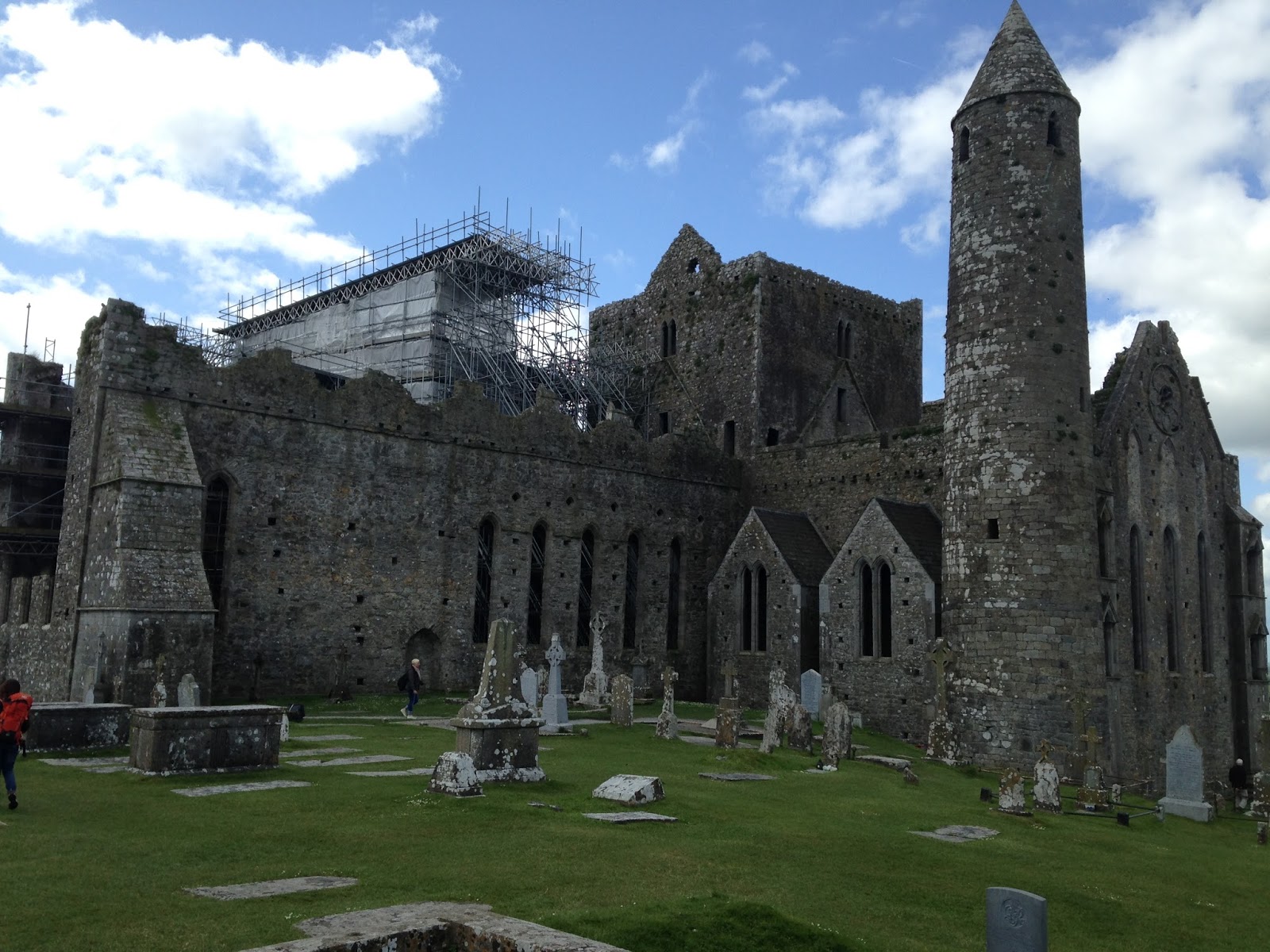
The Castle added in the 1400s, shortening the nave, to the Cathedral on the Rock


Kearney's Castle, named for original builder, on a main street of Cashel proper, near a square. 

We also toured the Catholic Church, St. John the Baptist's and its cemetery.  These would have been ancestral "haunts" as well.  Tired from our hike all day we had lunch around 3PM.  Sausages and mashed potatoes in an overly ample serving with a side of french fries!  Two potato dishes in one meal, could this be Ireland? We skipped dinner unless you count the Jameson's and chocolate.


St. John the Baptist Catholic Church.  I know my GGGrandfather and GGGMother were here


 Tribute to your church, your parents, and forever, importantly, yourself


People here are so friendly and funny.  The stories are true about that.  Wherever we go we get into detailed hilarious fun talks that make the day both luxurious and full.  Kind of like trying to drop into the Port Townsend Co-op and get out with a pound of butter within a half-hour.  If you know what I mean, locals will.


Tourism is serious, hard study, fueled by coffee

Sunday, June 7, 2015

Road Trip to History

Day Four


This is the day that we leave Dublin for the road trip.  That means we are getting a car, that means we are driving on the left, that means I feel like I am getting sick at the thought.

But first we had a morning to kill.  Steve and I love old history, artifacts and archaeology. We thought the museum called Dublinia would give us a detailed view of the Viking presence here in Dublin, something that would make transparent the layers of occupation under our feet.  Not quite.

Dublinia is for kids.  It is Disney with no animatronics.  It is gory papier-mache battlers, wild-eyed mannequins in bear shirts (Ber - serk is "bear shirt" is bezerk), Catholic clerics being slaughtered, replicas of docks, markets, kitchens, and ships.  There is a whole exhibit on the use of latrines with a expressive guy in a tunic with his pants down - a loud speaker adds farting and groaning.  Thank God they refrained from smell-around, oh wait, they didn't.  It is for kids.

We did find an actual tunic and pants-wearing, amber and knife bedecked Irishman showing how coins were made.  We talked to him for about a half hour.  He is married to an American and spends winters in Phoenix exhibiting authentic medieval crafts at the big Renaissance Fair there.  (He is not with Society for Creative Anachronism for those of you who might wonder).  At the very end of the exhibit Dublinia discussed archaeological techniques and displayed maybe six authentic artifacts.  Those six artifacts were part of a room displaying a huge Dubliner protest —using photos of marchers and newspaper articles— protesting the construction of Dublin's City Council building's modern concrete and glass complex that placed itself squarely and forever on top of the hastily assessed actual site of the large Viking village that began the city.  The artifacts were a small portion of what they did manage to find.  When you leave the Dublinia building you realize you are directly across from the street from this site of cultural self-immolation. The modern building does little to provide consolation.

This image is already captioned, double click to read it

Moving on.

We rented a small car in downtown Dublin.  The young man at the desk (Steve thought he was about thirteen) asked us how long we were going to be in Ireland.  We answered a month, and without a second's space he replied "What could you possibly do for a month in Ireland? " When we asked him to give directions out to the highway, he said " Turn right and then you are on your own"

No truer words were ever spoken.  We lost ourselves amongst tiny roads, unmarked, and had ABSOLUTELY NO IDEA where we were.  I will report that it was neither my nor Steve's finest hour of composure nor mutual treatment.  Steve made a few errors, classic ones, which he now allows me to share.  He turned left into the right lane, with me screaming at him to pull left.  He soon overcompensated by running up onto the left curb of a road that fortunately had no parked cars.  After screaming and detaching myself from the gear console, I was literally shaking.  Adrenaline was pumping non-stop,  I started to have stress-induced asthma.  Everything about driving on the left is WRONG, everything I ever have been taught— I am supposed to undo instantly.  All of my goody two shoe nature and strict adherence to law has been ripped from its moorings.  The sun is rising in the goddamn west I tell you.  Only the relative peace of the less complex arrangement of an actual marked freeway led to any calm.  My other tranquilizer was our trusty phone that led us through every turn.  I clutched it a little too hard, making sure we did everything it said to get out of Dublin and get to Cashel, our next destination.

Cashel is the birthplace of my great-grandfather Patrick Butler who left Ireland at the age of fourteen.  The possibly apocryphal story is that he ran the Irish flag up the Castle Cashel in around 1855 and his parents, rather than see him go to jail for treason, placed him on a hay cart for the west coast of Ireland and he was on the boat to America and New York relatives within a week.  My question for our five days here is simply - could this be true?  Was this a story my grandfather told to garner Irish revolutionary points and bragging rights?  Was it to cover-up the real reason he came to America alone—perhaps he had gotten into less glamorous trouble?  Did his family just send him to America as the one sowing of one seed that the oldest son might reap benefit from?

Cashel is a lovely place set in a broad valley, the once walled city lies at the base of a limestone outcrop atop which have been iron age fortifications, fortified thatch-roofed villages, the seat of the Munster kings, and then around 1100 AD, the first Romanesque church in Ireland (with colorful frescoes found under reforming Protestant whitewash) and then a huge gothic cathedral.  This complex is the rightfully famous Rock of Cashel.  Our bed and breakfast (O'Brien's Cashel Lodge) is at the base of this with unobstructed views of the Rock and Hore Abbey (named Hore as its Cistercian monks wore undyed sheep wool robes that were as white as hoarfrost) in our front yard.  Note the cosmically beautiful photographs and soak it all in.


Rock of Cashel from our B and B, an unobstructed incredible view, note all of the jackdaw crows


Hore Abbey, across the street from our B & B


Late evening light at Hore Abbey


This is our B & B —O'Brien's Cashel Lodge.  We are in the upstairs room, left, a converted cow barn


Join me tomorrow as we begin our investigations of this story on "yet another exciting entry."


Saturday, June 6, 2015

Sea Sighed

Day Three

We are going to have to stop having so many serendipitous good times as I am not getting recreational reading accomplished.  Only this blog.

Today, as in yesterday, as in Friday which in many regards is Thursday in the States, as in precisely Friday June 5 we slept in.  I find myself referring to what time it is eight time zones away and I keep noting that you are all asleep most of the time that I think of you.

Today we only planned ONE THING!  We took the tram to Howth Head which is pronounced Hoath Head.  We learned that by mispronouncing it.  Howth is a forty minute ride away north of Dublin.  We chose it as a destination because it has interesting seabirds and we needed to get bang for our buck of a bus pass.

What a pretty spot.  I will let the photos speak for themselves.  We had a very nice lunch in a fish shop of two small plates, one of perfect prawn scampi and sauce, and the other of grilled mackerel with cannellini beans, sun dried tomatoes and green garlic pesto.  We planned to leave the working seaport there and stroll along a beach and up a hill to the lighthouse.


Fish Shops in Howth


Working waterfront in Howth


Steve had noticed a boat that had disgorged many passengers and looked like a ferry or tourist cruise so we stopped there and I asked, "Where are you going?"  Dun Laoghaire (pronounced Dunleary).  "Have you room for two passengers?" Yes. "How much is it?"  After some thought the money man gave us both senior citizen fares, these were listed next to a hunched man with a cane symbol.

The Captain had been in the Navy, in merchant shipping in the Middle East and he was quite charming and funny.  Now he plied Dublin Bay in his retirement, circumnavigating two bird and guano-covered isles and depositing people between Dublin's favorite fish market (Howth) and its favorite ice-cream consuming town— Dun Laoghaire.

We learned these distinctions from a married couple who were seeing Dublin from the water for the first time.  Though from Donegal in the north the woman had been to Dublin all her life to visit her grandmother but had never ridden a boat nearby.    The man was a birder and would yell things like "Razorbills!"  He confirmed my two lifelisters (that is a word to a birder) as Manx Shearwater and Black-legged Kittiwake.


 From Howth pier


 Leaving Howth


Howth Head Lighthouse


 Looking back toward Howth Head, lighthouse and island seen above


Dun Laoghaire pier

We really just stumbled on this trip, my mini-pelagic bird trip.  If we had lingered at lunch we would have missed it.  Because we never planned it there was neither the stress of making sure we got there on time nor would there have been any sense of loss had we missed it.  This is stress free travel.